
Key Skill Achievements
Project Info
🎯 Project goal: Showcase how warehouse logistics centers can benefit from adopting environmentally friendly solutions.
👨👨👧👧 Target audience: Young Students
📺 Platform: Meta Quest 3/2 & PC
👩🏻💻 Language: C#
⏳ Timeline: 2 months
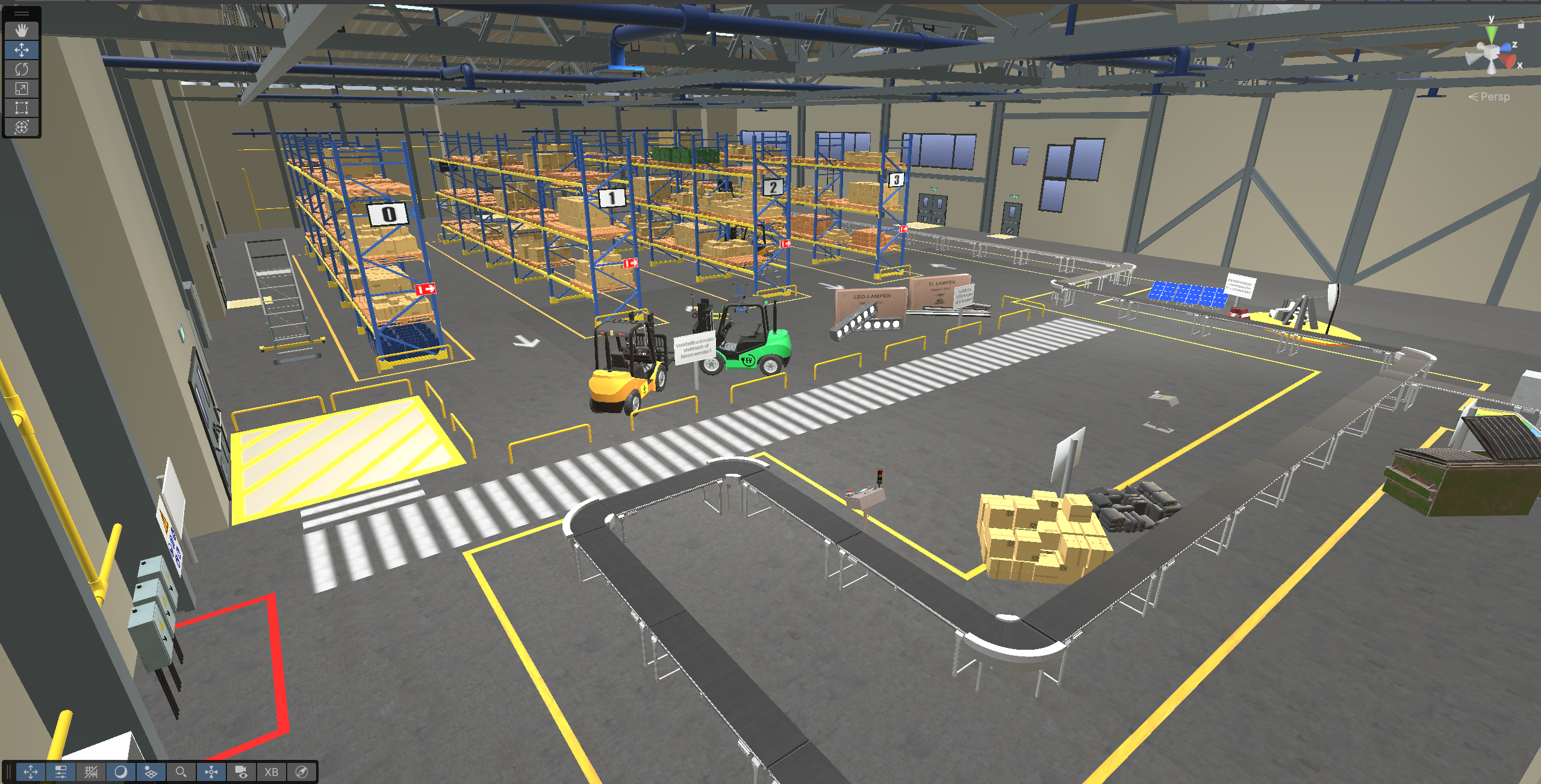
I led the development of an interactive VR awareness experience designed to demonstrate how warehouse
logistics centers can benefit from adopting environmentally friendly solutions>. The project aimed to
clearly communicate the operational and environmental advantages of sustainable choices (such as electric
forklifts, LED lighting, and recyclable packaging)in a way that was engaging, understandable, and suitable
for live expo demonstrations.
The experience was built to support client presentations and public events,
balancing technical feasibility, clarity of messaging, and immersive presentation.
Gameplay:
My contributions:
The VR experience was designed for live expo environments, where background noise made audio-only guidance unreliable.
To address this, I proposed a hybrid guidance system combining voice instructions with adaptive floating subtitles.
Subtitles appear just below the player’s line of sight during normal forward view and reposition dynamically to the center of view
when the player looks down. This approach significantly improved accessibility, clarity, and user guidance, and was
very well received by both the client and expo attendees.
I led a client-facing project focused on demonstrating the benefits of environmentally friendly solutions in warehouse logistics,
highlighting how sustainable choices (such as electric forklifts, LED lighting, and recyclable packaging)
can improve efficiency while reducing environmental impact.
I researched the target audience (young adults and students) and designed the training scenario
to match their learning needs and level of experience.
Based on this research, I created and prototyped interactive scenarios that were easy to understand,
engaging, and effective for first-time learners.
As project lead, I planned the work, coordinated the team, and stayed in close contact with the client.
I also took part in the final presentation, demonstrating the VR experience and explaining the design
choices and training goals to stakeholders.
Using the Unity Profiler, I implemented targeted performance optimizations by restructuring
expensive systems and removing physics checks and raycasts from the Update loop, refactoring them
into an observer-based architecture. Scene performance was further improved through the use of
LOD groups for distant assets, object pooling for frequently spawned elements,
baked lightmaps in place of real-time lighting, and occlusion culling. Frequently reused
assets followed flyweight principles and were marked static to minimize draw calls and memory overhead.
The experience was built for client presentations and public expo environments, ensuring
stable frame rates, clear user guidance, and a reliable, repeatable demo across both
Meta Quest 2 and Meta Quest 3 standalone devices.